
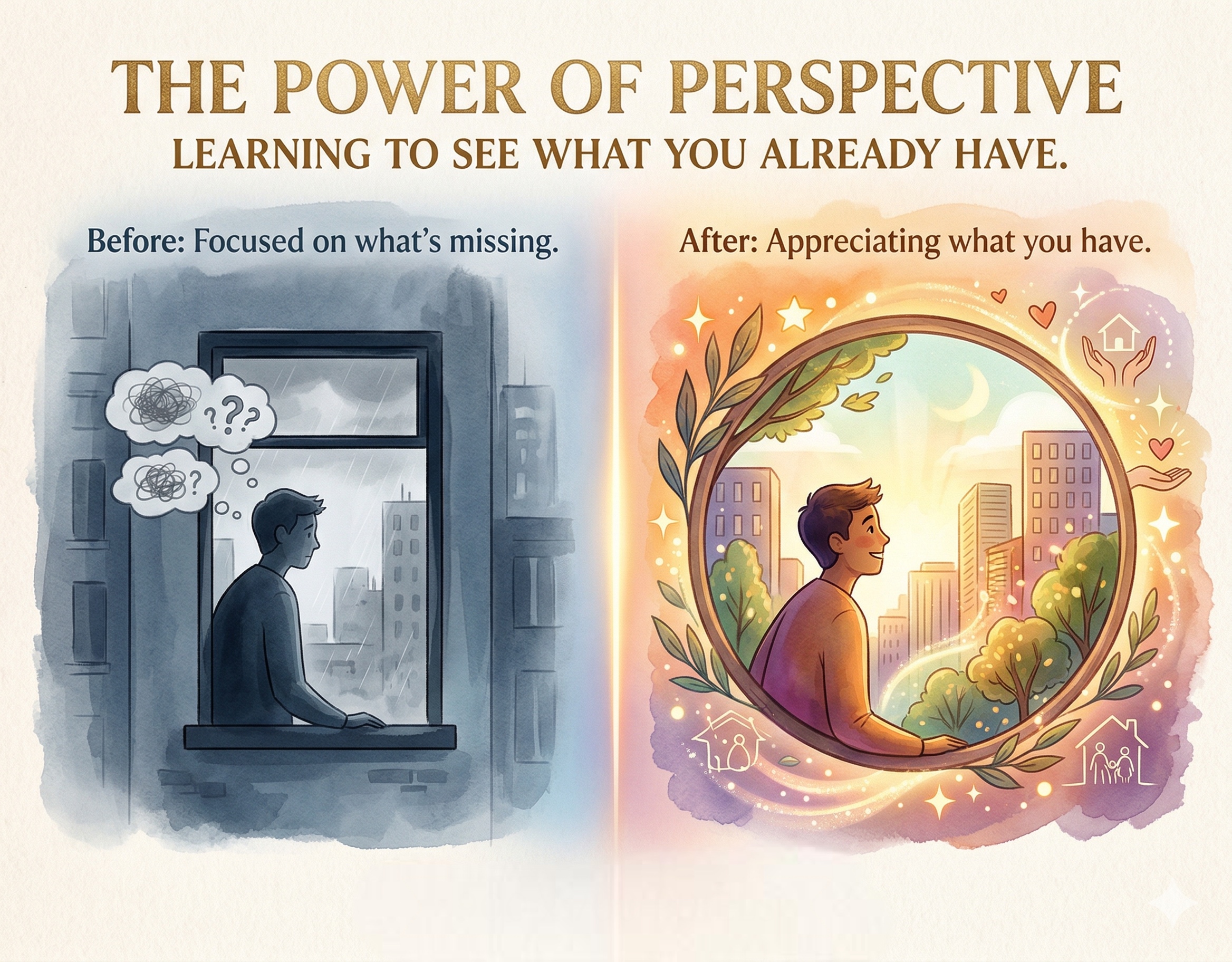
There is a subtle but powerful shift that occurs when a person stops dwelling on what they do not have and begins to focus on what they already possess. This shift is not merely emotional or motivational. It is deeply spiritual and practical, shaping how we think, act, and ultimately live.
Many people unknowingly train their minds to fixate on lack. They measure their lives by what is missing, delayed, or seemingly out of reach. Over time, this creates a pattern of dissatisfaction. Even when something good is present, it is overshadowed by what is absent. This way of thinking leads to frustration, comparison, and a constant sense of insufficiency.
Scripture addresses this condition directly. In Philippians 4:11, Paul writes, “I have learned in whatever state I am, to be content.” This statement is not passive acceptance, it is learned perspective. Paul understood that contentment is not based on external conditions but on internal alignment.
When you begin to dwell on what you have, your awareness changes. You start to recognize the value of what is already in your life. What once seemed ordinary begins to carry weight and significance. Relationships, skills, opportunities, and even small provisions become visible in a new way.
This aligns with 1 Thessalonians 5:18 which says, “In everything give thanks; for this is the will of God in Christ Jesus for you.” Gratitude is not a reaction to perfection, it is a discipline that reorients your thinking. It anchors you in truth rather than perception.
From a practical standpoint, this shift increases clarity. When your mind is no longer consumed by what is missing, you can think more strategically about what is available. You begin to ask better questions. What can I build with what I have? What can I improve? What can I multiply?
In Exodus 4:2, when Moses questioned his capacity, God responded with a simple question: “What is that in your hand?” Moses was focused on his limitations, but God redirected him to what he already possessed. The staff in his hand became an instrument of power, not because it changed, but because his perspective did.
This reveals a principle. What you focus on determines what you develop. If your attention is fixed on lack, you will underutilize your present reality. If your attention is fixed on what you have, you position yourself to maximize and multiply it.
Jesus reinforces this in Luke 16:10, “He who is faithful in what is least is faithful also in much.” Faithfulness begins with recognition. You cannot steward what you refuse to acknowledge. Growth is often less about acquiring more and more about properly managing what is already within reach.
It is important to understand that this perspective does not ignore desire or ambition. It does not deny that there are things you are believing for. Instead, it establishes a foundation. You move forward not from frustration, but from stewardship.
When you stop dwelling on what you do not have and start dwelling on what you have, you regain control of your focus. You break the cycle of comparison. You cultivate gratitude. You unlock creativity, and you begin to see that what you already carry may be more than enough to take your next step.
The transformation begins in the mind, but its effects are seen in every area of life.
Question for reflection: What are you currently overlooking that, if fully recognized and stewarded, could become the very foundation for your next level?
If this article has blessed you in anyway, consider sharing and leaving a comment below. Thank you!
Kingdom Blessings!
—Benhail E. Chris ✍🏾