
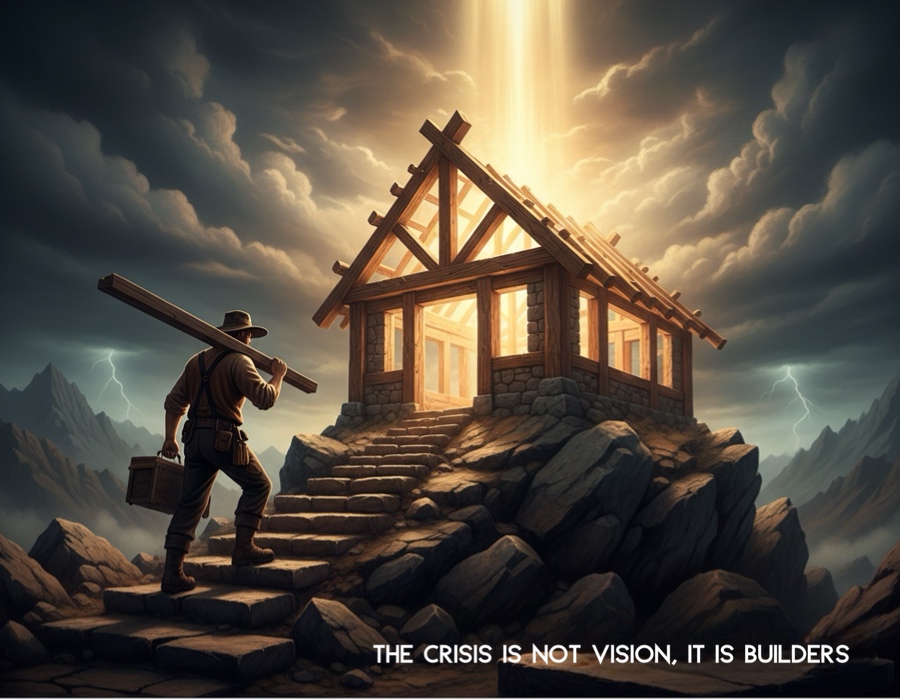
This generation does not suffer from a lack of vision, it suffers from a lack of BUILDERS!
As I began to seek the Lord in prayer while preparing to speak at a conference I have been invited to this week on the theme “Activating the Builders Anointing”, a simple but weighty thought began to take shape in my spirit. What the Lord impressed upon my heart was not new insight, but needed clarity. The challenge facing the Church and the culture is not a failure of vision, but a shortage of people willing to carry responsibility over time.
We live in a time saturated with critique and commentary. Platforms amplify voices that can diagnose problems with remarkable precision. Many can name what is broken but far fewer are willing to accept responsibility for repairing it.
This is not a new dilemma. Scripture shows that moments of greatest clarity often coincide with moments of greatest reluctance to build. Vision is easier than obedience, and insight travels faster than faithfulness. But the Kingdom of God has never advanced through commentary, it has always moved forward through builders willing to carry weight over time.
Jesus made this distinction unmistakably clear: “Everyone who hears these words of mine and does them will be like a wise man who built his house on the rock” (Matthew 7:24). Hearing was not enough, agreement was not enough. Wisdom was proven only through construction. When the storms came, as they inevitably do, they did not test ideas, they tested what had been built.
Throughout Scripture, builders are rarely chosen for their eloquence. They are chosen because they remain when others withdraw. Noah preached righteousness for decades, but his obedience was measured in timber, sweat, and years of unseen labor. Hebrews 11:7 records that “by faith Noah… prepared an ark for the saving of his household.” Preparation demanded endurance, ridicule, and faithfulness long before results were visible. Vision alone would not have saved anyone in Noah’s generation.
Moses, too, was not chosen for his speech. He resisted his calling on the basis of inadequacy. Yet God entrusted him with the formation of a nation because he was willing to return to Egypt, confront power, and shepherd a people through the slow grind of wilderness formation. Deuteronomy records repeated rebellion, but Moses carried the burden regardless. Builders remain faithful even when obedience outpaces outcomes.
After the exile, the pattern continues. Nehemiah did not arrive in Jerusalem with rhetoric, he arrived with a burden, a plan, and resolve. When mocked, threatened, and opposed, he answered, “I am doing a great work and I cannot come down” (Nehemiah 6:3). His authority did not come from position, it came from commitment. Builders understand that restoration does not happen through debate.
The New Testament reinforces this truth. Paul described himself as “a wise master builder” (1 Corinthians 3:10), yet he clarified that his task was to lay foundations, not collect admiration. He warned that each person must take care how they build. Materials matter, motives matter. Time reveals everything. Fire tests work, not intention.
Modern culture often reverses this order; visibility is mistaken for authority. Platforms are confused with calling. Influence is substituted for responsibility. Yet the Kingdom of God does not operate on attention; it operates on faithfulness. Jesus taught, “Whoever is faithful in little is faithful also in much” (Luke 16:10). Builders are proven in obscurity long before they are trusted with scale.
The present moment is marked by moral confusion, institutional fatigue, and deep distrust. Many see it clearly and speak boldly about it. But Scripture never treats awareness as the solution. Awareness is but the invitation and responsibility is the response. James warns, “Be doers of the word, and not hearers only, deceiving yourselves” (James 1:22). The deception is subtle: believing that agreement equals obedience.
Builders accept delay, they understand process. They remain when progress feels slow and results appear fragile. I can personally relate to this. Hebrews 12 speaks of endurance, discipline, and strengthening what is weak. This is practical instruction not abstract theory. Building requires correction, perseverance, and the willingness to bear weight over time.
History confirms this pattern. Monastic communities preserved Scripture through centuries of instability. Reformers translated texts and trained leaders over decades. Missionaries built schools, hospitals, and churches long before cultures were transformed. None of these movements were sustained by vision alone. They endured because people chose to build when no one was watching.
The Kingdom does not advance through outrage or nostalgia. It advances through faithful labor. Jesus said, “My Father is working until now, and I am working” (John 5:17). To follow Him is to adopt the same posture; quiet, consistent, and grounded in truth.
The question facing this generation is not whether we can see what is wrong. Yes, we can! But the question is whether we are willing to shoulder responsibility long enough to repair it. Builders do not wait for ideal conditions, they respond to the call in front of them. Vision reveals the need, builders answer it.
If this post has encouraged or blessed you, consider sharing a comment below. Thank you!
Kingdom Blessings!
—Benhail E. Chris ✍🏾